
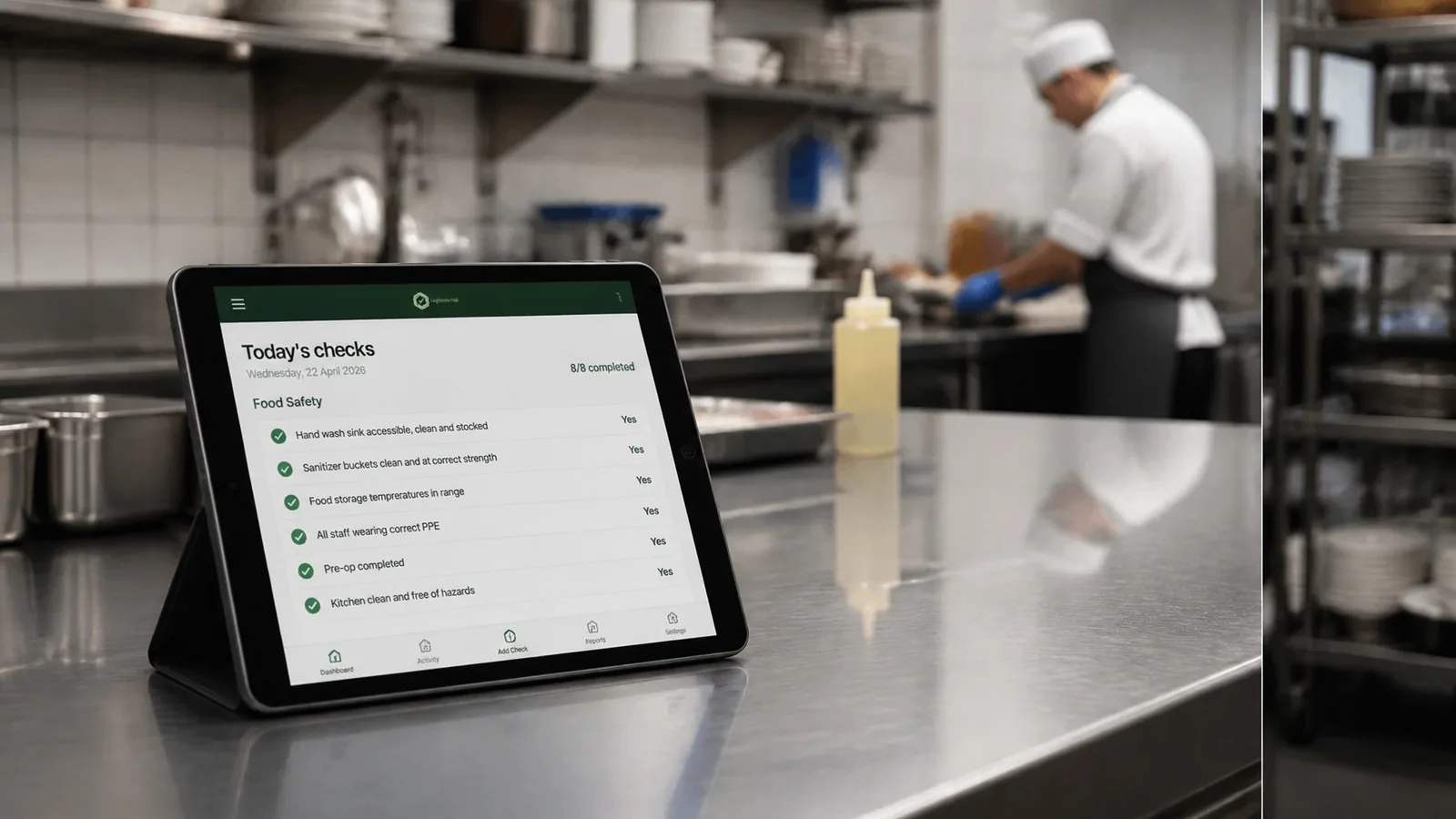
Most UK food businesses think they're compliant because they keep records. In reality, seven common FSMS mistakes—from generic HACCP plans to backdated logs—wouldn't survive an EHO inspection. Here's how to fix each one.
Quick answer
The seven most common Food Safety Management System mistakes are: relying on generic HACCP plans, managing compliance on paper, backdating records, failing to capture visual evidence, poor staff accountability, ignoring data trends, and being unprepared for audits. Each is fixable by moving to a digital, timestamped, audit-ready logbook system.
Maintaining a Food Safety Management System (FSMS) is a statutory requirement for any food business in the United Kingdom. For small and medium-sized enterprises (SMEs) in the hospitality and food service sectors, managing these systems often becomes a secondary administrative burden. However, a failing FSMS does more than jeopardise a hygiene rating. It exposes a business to significant legal liability, insurance disputes, and potential closure.
Most businesses believe they are compliant because they maintain records. In reality, many are making fundamental errors that would not withstand the scrutiny of an Environmental Health Officer (EHO) inspection.
This article identifies seven common mistakes in food safety management and provides technical solutions to ensure your operations remain audit-ready.
1. Relying on Generic, Non-Tailored HACCP Plans
A common error among restaurants and cafes is the adoption of a "one-size-fits-all" Hazard Analysis and Critical Control Point (HACCP) plan. Generic templates often fail to account for specific equipment, unique menu items, or the physical layout of a kitchen.
When an FSMS does not reflect actual operations, it ceases to be a safety tool and becomes a compliance liability. EHOs prioritise systems that demonstrate a clear understanding of specific risks.
The Fix
Use industry-specific digital templates that allow for precise customisation. LogBooks Hub's digital logbook templates are designed to be adapted to your specific workflows, ensuring that every Critical Control Point (CCP) recorded is relevant to your actual daily processes.
2. Managing Compliance via Manual Paper Records
Manual record-keeping is inherently flawed for modern food service operations. Paper logs are susceptible to damage, loss, and physical degradation in kitchen environments. Furthermore, paper records are static. They offer no real-time oversight, meaning a manager may only discover a missed temperature check days after the event.
The administrative overhead of filing and storing years of physical paperwork is a significant drain on SME resources.
The Fix
Transition to a digital logbook platform. Digital records are centralised, searchable, and secure. Moving compliance to a cloud-based system ensures that records are never lost and are accessible from any location, providing instant oversight of multi-site operations.
3. Retrospective Logging and Record Backdating
Backdating records—the practice of filling in missed logs at the end of a shift or week—is a frequent occurrence in busy kitchens. This practice is technically fraudulent and easily identified by experienced inspectors. Traditional paper logs offer no proof of when a record was actually created.
When an inspector identifies "pencil whipping" (completing logs without performing the checks), the entire FSMS is deemed unreliable. This often leads to a significant downgrade in the Food Hygiene Rating.
The Fix
Implement a system with immutable timestamps and AI-powered fraud detection. LogBooks Hub records the exact second a check is performed. Our AI tools analyse submission patterns to detect anomalies, such as multiple temperature logs submitted within seconds, ensuring your data remains honest and audit-grade.
4. Failing to Capture Visual Evidence
A numerical temperature reading on a log sheet is a claim, not a proof. In the event of a food poisoning allegation or a rigorous audit, a single number provides limited protection. Many businesses fail to document the physical state of their premises or the actual process of a check.
Visual evidence is particularly critical for cleaning schedules and equipment maintenance logs, where a "tick" in a box carries little evidentiary weight.
The Fix
Use the LogBooks Hub mobile app to capture photo evidence in-line with your records. Staff can photograph a probe thermometer in situ or a cleaned prep station. These images are automatically embedded into the record, providing an irrefutable layer of proof for every compliance check.
5. Poor Staff Accountability and Task Oversight
In many SMEs, food safety tasks are assigned verbally. Without a structured tracking system, it is difficult to determine which staff member was responsible for a specific check. This lack of accountability leads to skipped checks during peak hours.
Furthermore, managers often lack a high-level view of daily progress. If a fridge temperature exceeds the safety limit at 9:00 AM, the manager may not be notified until 5:00 PM, by which time the stock may be compromised.
The Fix
Utilise a real-time compliance dashboard. The LogBooks Hub app provides a live feed of all due, overdue, and completed tasks. Individual operator IDs and signatures are attached to every record, ensuring clear accountability. Automated alerts notify management immediately when a check is missed or a critical limit is breached.
6. Ignoring Data Anomalies and Trends
Many business owners view food safety logs as a "check-box" exercise rather than a source of operational data. A fridge that is consistently operating at 7.9°C is technically within the 8°C limit but indicates a potential mechanical failure. Paper systems make it nearly impossible to spot these trends over time.
Ignoring these anomalies leads to equipment failure, food waste, and increased insurance premiums.
The Fix
Deploy AI-driven analysis. LogBooks Hub analyses your recorded data to identify gaps and anomalies. By surfacing a "fit-for-audit" view, the system alerts you to issues before they become non-conformities during an inspection.
7. Delayed Audit Readiness
The standard response to an EHO inspection notification is a frantic search for missing paperwork and the late-night completion of logs. This lack of readiness is a primary cause of stress for pub and bar managers.
If an inspector requests a specific cooling log from six months ago, a delay in finding that record suggests poor management and may lead to a more intrusive audit.
The Fix
Adopt one-click audit pack generation. Instead of handing over a stack of folders, you can generate a signed, immutable PDF evidence package instantly. These packs include all timestamped records, photo evidence, and operator signatures, organised in a format that inspectors prefer. This demonstrates a level of professional control that significantly improves your standing with regulatory bodies.
Conclusion: Compliance on Autopilot
A Food Safety Management System should not be a burden that distracts from the core goal of serving customers. By moving away from manual, paper-based processes and adopting a digital-first approach, SMEs can achieve a state of "Compliance on Autopilot."
The transition to digital logbooks eliminates common errors like backdating and lost records while providing the visual proof necessary to protect your business. For owners and managers in the hospitality sector, this shift represents the difference between surviving an inspection and excelling in one.
To secure your compliance and prepare for your next audit, explore the LogBooks Hub platform and start your digital transition today.
Public sector compliance?
Need compliance software for schools, care homes, or GP practices? See ReflowAI — specialised compliance software for public sector operations.