
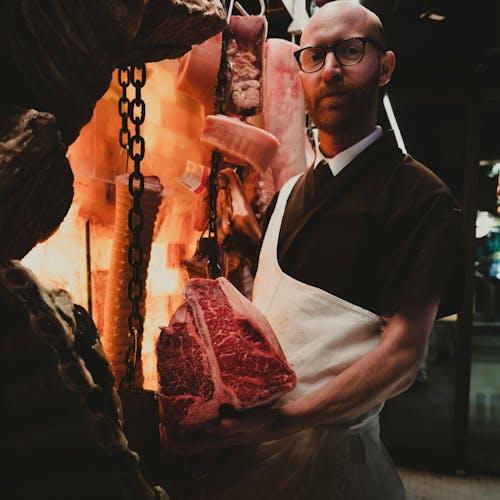
Food safety records and digital compliance logbooks for UK butcher shops

    A butcher's shop handles raw meat all day, and many also sell cooked meats, pies or other ready-to-eat food. Keeping those two apart is the single biggest food safety job you have, and the one the environmental health officer (EHO) will look at hardest.

    This page sets out what UK butchers should log, how often, and how the FSA's E. coli O157 guidance shapes those records.

    What a butcher shops business needs to record

    RecordHow oftenWhy it matters
    Chiller, cold room and display temperaturesAt least twice a dayChilled food must be kept at 8°C or below in England, Wales and Northern Ireland; the FSA advises 5°C or below.
    Raw and ready-to-eat separation checkDaily, at openingConfirms separate areas, equipment, utensils and storage are in place, as the E. coli O157 guidance expects.
    Cleaning and disinfection of surfaces and equipmentDuring and after each use, plus daily and weekly deep cleansDisinfectants must meet BS EN 1276 or BS EN 13697. The log shows which product, where and when.
    Mincer, slicer and vacuum packer cleaningAfter every use, and before any change of useComplex equipment should not be used for raw and ready-to-eat food in the same day; switching needs full dismantling and disinfection.
    Deliveries (goods in)Every deliveryChecks meat temperature and condition on arrival and records the supplier for traceability.
    Cooking and hot holding (if you cook on site)Each batchShows cooked meats reached a safe core temperature, such as 70°C for 2 minutes, and hot food was held at 63°C or above.
    Allergen information and PPDS labelsWhenever a recipe or supplier changesSausages, burgers and marinated products often contain allergens such as cereals containing gluten, mustard or sulphites.
    Use-by date and stock rotation checksDailyRaw meat past its use-by date is treated as unsafe and must not be sold.
    Staff illness and handwashing trainingWhen reported; at induction and refreshersStaff with diarrhoea or vomiting must stay off until 48 hours after symptoms stop.

    Who checks your records

    • Local authority environmental health

      Inspects food hygiene, gives your food hygiene rating and checks your E. coli O157 controls. Councils also usually enforce health and safety in retail premises, including machinery such as bandsaws and mincers.

    • Food Standards Agency (FSA) and Food Standards Scotland

      Publish the E. coli O157 cross-contamination guidance that councils use when they inspect butchers. The FSA version covers England, Wales and Northern Ireland; Scotland has its own.

    • Trading Standards

      Deals with labelling and food sold past its use-by date.

    • Fire and rescue authority

      Enforces the Regulatory Reform (Fire Safety) Order 2005 in England and Wales. Scotland and Northern Ireland have their own fire safety law.

    If your records are missing

    In a butcher's, the officer will want to see how you keep raw and ready-to-eat food apart, and how you clean and disinfect. If you cannot show it, expect it to affect the management part of your food hygiene rating. A serious risk of cross-contamination can lead to a Hygiene Improvement Notice, or a Hygiene Emergency Prohibition Notice that stops a process or piece of equipment straight away (GOV.UK).

    If illness is ever linked to your shop, records are your evidence that you took all reasonable precautions under the due diligence defence in section 21 of the Food Safety Act 1990.

    Quick answer

    UK butchers should log chiller temperatures at least twice a day, daily checks that raw and ready-to-eat food are kept apart, cleaning and disinfection of surfaces and machines, deliveries, allergens and staff illness. If you sell both raw and ready-to-eat food, the FSA's E. coli O157 guidance sets the standard your council will inspect against.

    Why E. coli O157 matters so much to butchers

    E. coli O157 can be carried on raw meat and spread on hands, surfaces and equipment. Thorough cooking kills it, which is why the danger is raw meat contaminating food that will not be cooked again: cooked ham, pies, pâté, salads.

    The FSA's E. coli O157 guidance applies to any business handling both raw and ready-to-eat food in England, Wales and Northern Ireland. Food Standards Scotland publishes the Scottish version.

    What the guidance expects

    ControlWhat it means in a butcher'sRecord to keep
    SeparationSeparate areas, surfaces, equipment and utensils for raw and ready-to-eat food. This can include separate rooms or staff.Daily separation check
    Complex equipmentVacuum packers, slicers and mincers should not be used for both raw and ready-to-eat food during a normal business day.Equipment use and cleaning log
    Change of useIf a machine must switch from raw to ready-to-eat, it has to be dismantled so every surface can be cleaned and disinfected.Dismantle-and-clean sign-off
    Shared areasCleaning and disinfecting a shared area between uses is allowed but carries the most risk.Time-stamped cleaning entries
    HandwashingWash hands properly. Gels can support but not replace handwashing. Gloves are not a substitute.Training record
    DisinfectantsUse products that meet BS EN 1276 or BS EN 13697, as the label directs.Product and contact time on the cleaning schedule

    Common gaps in butchers' records

    • A single vacuum packer used for raw and cooked products, with no record of how it was cleaned between.
    • Cleaning logged as "done" with no product named, so nobody can show it was a proper disinfectant.
    • Cooked meats stored below raw in the same chiller.
    • Allergen information for sausages and burgers not updated after a rusk or seasoning supplier changed.

    Burgers, sausages and other products you make and pack before sale are prepacked for direct sale (PPDS). Since 1 October 2021 they need a label with the name, an ingredients list and any of the 14 allergens emphasised (FSA guidance).

    Proof at the block

    With LogBooks Hub, staff log a clean or a chiller reading on a phone in the shop, with a timestamp and an optional photo of the dismantled machine. Reminders flag a missed check, and the one-click audit pack PDF gives the EHO the full picture. Plans start from £30/month.

    LogBooks Hub logbooks for butcher shops

    These come ready to use from our 90+ digital compliance logbooks. Each one reminds staff when a check is due, records who did it and when, and can hold a photo as evidence.

    • Chiller and cold room temperature log
    • Freezer temperature log
    • Display counter temperature log
    • Raw and ready-to-eat separation check
    • Cleaning and disinfection schedule
    • Mincer, slicer and vacuum packer cleaning log
    • Goods-in delivery checks
    • Cooking and hot holding temperature log
    • Allergen matrix
    • Use-by date checks
    • Staff illness and fitness to work
    • Staff training record
    • Pest control checks

    Free printable versions: Fridge and freezer temperature log, Opening and closing checks, Cleaning schedule, Goods-in and delivery checks, Cooking, cooling, reheating and hot holding log, Allergen matrix.

    Frequently asked questions

    Can a butcher use the same vacuum packer for raw and cooked meat?

    The FSA's E. coli O157 guidance says complex equipment such as vacuum packers, slicers and mincers should not be used for both raw and ready-to-eat food during a normal business day. If a machine must change use, it has to be dismantled so every surface can be cleaned and effectively disinfected. Most butchers solve this with separate machines.

    Is the E. coli O157 guidance a legal requirement?

    The guidance itself is not law, but it explains how to meet the legal duty to control food safety hazards. Councils use it when they inspect businesses that handle raw and ready-to-eat food. If your controls fall short of it, expect the officer to ask you to justify your approach or to take action.

    What temperature should a butcher's chiller be?

    By law, chilled food must be kept at 8°C or below in England, Wales and Northern Ireland, and this is recommended in Scotland. The FSA advises setting fridges at 5°C or below. Check display counters as well as cold rooms, because they warm up during service and when the shop is busy.

    What disinfectant should a butcher use?

    Use a product that meets BS EN 1276 or BS EN 13697. Those codes on the label show it meets the standard for killing bacteria. Follow the manufacturer's instructions for dilution and contact time, and record which product you used on your cleaning schedule.

    Do butchers need allergen labels on sausages and burgers?

    If you make and pack them before the customer asks for them, they are prepacked for direct sale (PPDS). Since 1 October 2021 they need a label with the name of the food, a full ingredients list and any of the 14 allergens emphasised. Loose products sold over the counter need allergen information available, in writing or verbally.

    How long should a butcher keep food safety records?

    There is no single fixed legal period for daily checks. FSA guidance for SFBB users says to keep diary pages until your next inspection, and many butchers keep them for a year or more to support a due diligence defence. Supplier traceability records must be kept so you can trace meat back if needed.

    Official guidance and sources

    This page is general guidance, not legal advice. Rules differ between England, Scotland, Wales and Northern Ireland; check with your local authority if you are unsure.

    Keep these records on your phone

    Works on any device in the browser, or grab the iPhone or Android app. From £30 a month for one site and two users.