
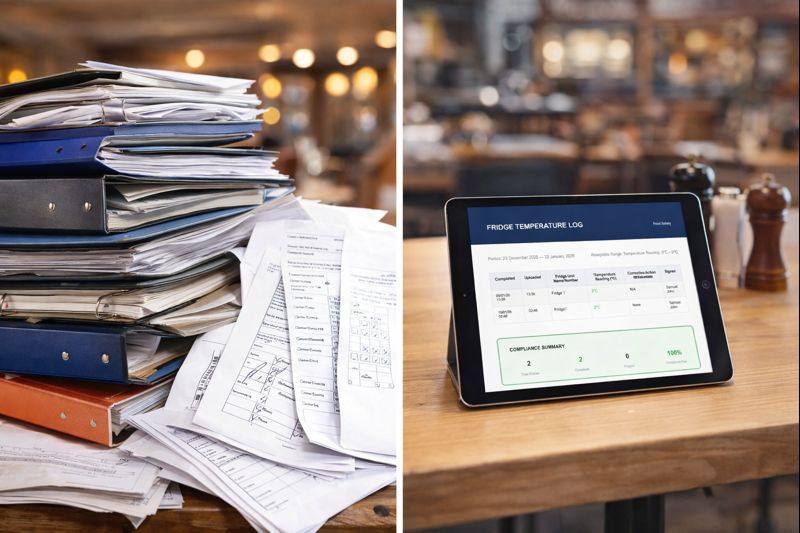
Digital food safety logbooks cost £30–£50/month but save 6–8 hours weekly. Compare true costs including hidden paper logbook expenses and audit prep time.
Quick answer
Digital food safety logbooks cost £30–£50 per site monthly but save 6–8 hours per week in admin time. Paper logbooks cost £50–£100 annually but create hidden costs: lost records, failed inspections, manual audit prep taking 2–3 hours, and no trend visibility across sites.
What's the True Cost of Paper Logbooks?
On the surface, paper logbooks look cheap. A set of food safety record books runs £50–£100 per year. If you're comparing that headline figure to a monthly software subscription, paper wins easily.
Except the headline figure isn't the real cost.
The real cost is the 20 to 30 minutes your chef or supervisor spends every day filling in temperature logs, cleaning checklists, and delivery records by hand. Across a week, that's two to three hours of paid staff time on paperwork. Across a year, it's 100 to 150 hours — at real labour cost, not stationery cost.
Then there are the records that get damaged, misfiled, or lost entirely. A water-damaged logbook from six months ago isn't evidence of compliance — it's a liability. Environmental Health Officers are experienced enough to notice gaps in paper records, and a gap has only one interpretation available to them.
There's also the audit preparation problem. When an EHO visit is announced — or more commonly, unannounced — someone has to locate every relevant logbook, check it's complete, and present it coherently. In most hospitality businesses, that process takes two to three hours of a manager's time. In a multi-site operation, it's a logistical exercise that often requires pulling records from multiple locations.
Finally, paper gives you no trend visibility. You can't look at three months of temperature logs and spot that your prep fridge is drifting consistently warm before the thermostat fails. You just find out when it fails — and potentially lose a fridge full of stock in the process.
The real paper logbook cost breakdown, annually:
| Cost Category | Annual Cost |
|---|---|
| Logbooks and stationery | £50–£100 |
| Staff time completing records (2–3 hrs/week at avg hospitality wage) | £1,400–£2,200 |
| Audit preparation (2–3 hrs per EHO visit, 2–4 visits/year) | £200–£600 |
| Incidents from undetected equipment drift | Variable |
| Risk of failed inspection requiring re-visit | Regulatory and reputational cost |
| Total real annual cost | £1,650–£2,900 per site, minimum |
What Do Digital Food Safety Logbooks Actually Cost?
LogBooks Hub runs at £30–£50 per site per month, depending on your plan and number of locations. That's £360–£600 per year at the entry level.
Against a stationery budget, that looks expensive. Against the real cost of paper, it doesn't.
A few things worth knowing before you run the comparison:
- No hardware required. Staff complete checks on their existing smartphones or any tablet already in the kitchen. No dedicated device to purchase, no installation engineer to book, and no ongoing hardware maintenance cost.
- Multi-site discounts apply. Franchise groups and multi-site operators pay less per site as they scale. If you're running five or more locations, the per-site cost drops meaningfully.
- The subscription covers everything. EHO-ready audit reports, HACCP compliance documentation, automatic temperature alerts, staff attribution on every entry, and multi-site dashboard access — no add-on modules or per-feature charges.
What you're actually buying isn't a digital version of a paper logbook. It's a compliance system that happens to replace paper logbooks — with audit-ready reporting, trend analysis, and the kind of multi-site visibility that a folder of paper books can never provide.
Where Digital Logbooks Save Money
The cost comparison only makes sense when you account for what digital food safety logbooks actually change in daily operations.
Staff time: 6–8 hours per week recovered
Digital check completion is faster than paper. Staff tap through a structured checklist on their phone rather than locating the right book, finding the right page, and writing legibly under kitchen conditions. The time saving varies by operation size, but across a typical hospitality business, 6–8 hours of admin time per week is recovered — time that goes back to food preparation, customer service, or management.
Audit preparation: 2–3 hours down to 10 minutes
When an Environmental Health Officer arrives, LogBooks Hub generates a complete, formatted compliance report on demand. Every temperature log, cleaning record, and delivery check — timestamped, attributed to a named staff member, and sorted chronologically — available in under two minutes. The two-to-three-hour scramble through filing cabinets doesn't happen.
No lost or illegible records
Paper records get wet, torn, faded, and misfiled. Digital records don't. Every entry is stored securely, retrievable by date or category, and exactly as legible the day an EHO asks for it as the day it was completed. There's no reconstruction, no explanation, and no uncertainty about what happened on a particular date.
Trend visibility prevents waste and failure
When temperature data is digital, patterns become visible. A fridge that runs consistently 0.5°C warm shows up as a trend before it becomes a problem. A supplier whose delivery temperatures are regularly borderline shows up as a pattern before it becomes a compliance issue. Paper logs sit in a folder and tell you nothing until someone reads every page — which nobody does.
Across a typical single-site operation, the annual saving runs to £1,200–£2,300 compared to paper. For multi-site operators, where audit preparation and management overhead multiply across locations, the saving scales considerably.
When Paper Logbooks Still Make Sense
It would be dishonest to argue that digital logbooks are the right answer for every food business. For some operations, paper remains a reasonable choice.
Very small operations with simple compliance requirements
A sole trader running a market stall, a two-person sandwich shop with a straightforward HACCP plan, or an owner who personally completes every check and has no staff — these operations may find that a well-maintained paper logbook is adequate, proportionate, and cheaper over three years.
Operations with no multi-site oversight need
The multi-site visibility that digital provides is one of its strongest advantages. If you have one site and no plans to expand, that advantage doesn't apply to you.
Owners completing all checks personally
Much of the administrative overhead of paper logbooks comes from managing staff completion — chasing missing entries, deciphering handwriting, verifying that checks actually happened. If you're personally completing every check and confident in your own record-keeping, the management overhead is lower.
If any of these describe your operation today but might not in 12 months, it's worth thinking ahead. Transitioning from paper to digital mid-growth is more disruptive than starting digital from the point at which you need it.
How to Transition from Paper to Digital
The most common reason food businesses delay switching is anxiety about the transition — particularly around existing records and staff training. Both concerns are simpler than they tend to feel.
Keep your paper records for two years
There is a legal requirement to retain food safety records, and your existing paper logbooks satisfy that requirement for the period they cover. You don't need to scan or migrate them. They stay in the filing cabinet, available if needed, while your digital records run forward from go-live.
Start digital from your go-live date — no migration needed
LogBooks Hub is set up with your site's specific checks, schedules, and HACCP requirements before you go live. On day one, staff complete checks digitally. Your historical paper records cover everything before that date. There is no gap, and there is nothing to import.
Train staff in 30 minutes
The staff-facing interface is a structured checklist on a phone. Most staff are comfortable with it within a single session. LogBooks Hub onboarding includes a 30-minute walkthrough for your team, with support available during your first two weeks. See how it works on the product page.
Run parallel for one to two weeks if it helps
Some operators prefer to complete both paper and digital checks for a short period while staff build confidence. It creates a small amount of duplication, but it eliminates any anxiety about records continuity. After two weeks, paper stops. Digital continues.
The transition is typically less disruptive than the decision to transition. Most LogBooks Hub customers describe the first week as the most uncertain, and the second week as the point at which they stop thinking about it.
Frequently Asked Questions
Are digital food safety logbooks accepted by Environmental Health Officers?
Yes. EHOs accept digital records as fully equivalent to paper, provided they are complete, tamper-evident, and attributable to named individuals. LogBooks Hub records carry automatic timestamps and staff attribution on every entry, which often gives EHOs more confidence than hand-signed paper records — not less. The two-minute audit report has been used successfully across hundreds of EHO inspections.
What happens if the internet goes down?
LogBooks Hub works offline. Staff can complete checks without a connection, and records sync automatically when connectivity is restored. There is no risk of a missed check due to a broadband outage, and no requirement for a stable connection in the kitchen.
How long does it take staff to learn digital logbooks?
Most staff are confident completing checks independently within 30 minutes of their first session. The interface is a structured checklist on a smartphone — the same form factor staff already use for dozens of daily tasks. There is no complex system to learn, no login process to memorise beyond initial setup, and no manual to read.
Can I keep using paper for some checks and digital for others?
You can, but it's not recommended for anything you want to present to an EHO as a unified compliance record. Split records — some digital, some paper — require manual assembly at audit time, which reintroduces the problem digital is supposed to solve. The cleaner approach is to go fully digital from a defined date and keep prior paper records in storage. See our compliance templates for what's available.
Do I need to buy tablets or can staff use their phones?
Staff can use their own phones or any device already in the kitchen — a till tablet, a shared device in the back office, or a phone mounted near the prep area. LogBooks Hub works on any smartphone, tablet, or computer in the browser — or grab the iOS or Android app. No device-specific hardware is required.
What happens to my old paper logbooks when I go digital?
Keep them. The legal requirement is to retain food safety records for a minimum of two years (longer for some records under specific regulations). Your paper logbooks satisfy that requirement for the period they cover. Store them as you normally would. When they age out of the retention period, you can dispose of them. LogBooks Hub covers everything from your go-live date forward.
Is there a minimum contract length for digital logbooks?
LogBooks Hub offers monthly and annual billing. Monthly billing gives you flexibility with no long-term commitment. Annual billing gives you a discounted rate. There is no multi-year lock-in. See current options on our pricing page.
Public sector compliance?
Need compliance software for schools, GP surgeries, or care settings? ReflowAI covers operational compliance across education and health sectors.