
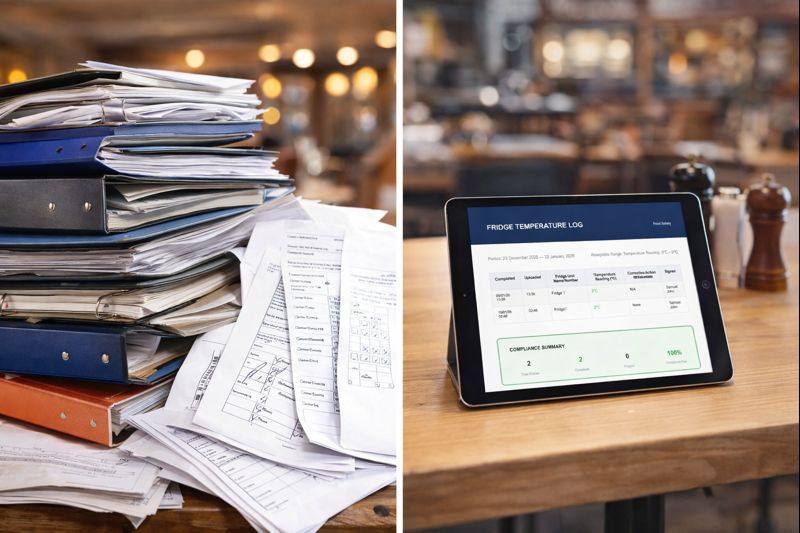
When an EHO arrives, the method you use to record your daily checks determines whether you sail through the inspection or scramble for missing records. This comparison evaluates paper and digital logbooks through the lens of a regulatory audit — and the verdict may surprise you.
Quick answer
For regulatory audits, digital logbooks are significantly superior to paper. Digital records provide immutable timestamps that prevent backdating, instant AI-powered fraud detection, one-click audit pack generation, real-time alerts for missed checks, and searchable historical records — none of which paper can match. Inspectors increasingly prefer digital because it offers greater transparency, accountability, and speed of retrieval.
Maintaining compliance is a critical requirement for any business in the hospitality, food service, or facility management sectors. Regulatory audits are inevitable. The method you choose to record your daily checks determines how you experience these inspections. Traditionally, businesses relied on paper-based systems. However, the emergence of digital platforms like LogBooks Hub has changed the standard for audit readiness.
Evidence Integrity and the Risk of Fraud
The most significant factor in any audit is the integrity of your data. An inspector must trust that the records you present are accurate and contemporary. Paper logbooks are prone to several integrity issues. Handwriting can be illegible, making it impossible to verify compliance. More importantly, paper records are susceptible to backdating. Inspectors are trained to identify these patterns.
LogBooks Hub addresses these risks with digital, audit-grade records. Every entry in a digital logbook is automatically timestamped — you cannot backdate a digital record. The platform uses AI-driven fraud detection to identify signature issues and inconsistent entry patterns, ensuring your records remain immutable and trustworthy. Photo evidence provides a timestamped, irrefutable layer of proof that a standard paper checklist cannot match.
Accessibility and Speed of Retrieval
During an audit, time is a critical factor. An inspector will request specific records from the past six months or a year. If you use paper logbooks, this process is often stressful. You must search through physical folders, often stored in different locations. Missing pages or damaged binders can lead to immediate non-compliance findings.
Digital logbooks provide instant access to your entire history of records. You can search for specific dates or types of checks in seconds. The Audit Pack Generation feature allows you to create a complete, signed PDF package with a single click — transforming the audit from a chaotic search into a structured review.
Proactive Alerts and Corrective Actions
Paper logbooks are reactive. You only discover a missed check or a failed temperature reading when you manually review the binder. By then, the window for corrective action has often closed. This creates gaps in your compliance history that an inspector will find.
Digital systems enable 'Compliance on Autopilot.' The LogBooks Hub platform monitors your tasks in real-time. If a staff member misses a scheduled check, the system sends an immediate alert to management. Furthermore, digital logbooks can force corrective actions — if a temperature is recorded outside of the safe range, the app requires the user to document the steps taken to fix the problem, creating a closed-loop audit trail.
The Administrative Burden and Cost
The hidden costs of paper logbooks are significant. Staff spend hours every week manually filling out forms and filing them away. Managers must then manually audit these papers to ensure they are complete. Digital forms are faster to complete, many fields are pre-filled, and centralised digital storage removes the need for physical filing cabinets.
Multi-Site Oversight and Standardisation
For businesses operating multiple locations, paper logbooks present a major logistical challenge. You cannot see the compliance status of a site without physically visiting it. Digital logbooks provide a central dashboard for all locations, ensuring standards remain consistent across your entire organisation. Whether you manage restaurants, hotels, or pharmacies, you can verify that every location is following your required protocols.
Final Verdict: Digital Is the Audit Standard
Paper logbooks are no longer sufficient for modern regulatory environments. The risks of lost data, backdating, and administrative inefficiency are too high. Inspectors increasingly prefer digital records because they provide greater transparency and accountability.
Ready to make the switch?
LogBooks Hub offers a comprehensive solution that replaces paper with digital, audit-grade records. Features like Compliance QuickCheck and AI-powered fraud detection provide a level of security that paper cannot match. By adopting a digital system, you ensure that your business is always prepared for its next audit.